Chocolate feels finished and simple by the time it reaches your hands — a smooth, snappable bar in foil. Getting there from a raw cacao pod takes roughly a dozen distinct steps, most of them invisible to the person eating the final product. Here’s the full process, start to finish.
Step 1: Harvesting
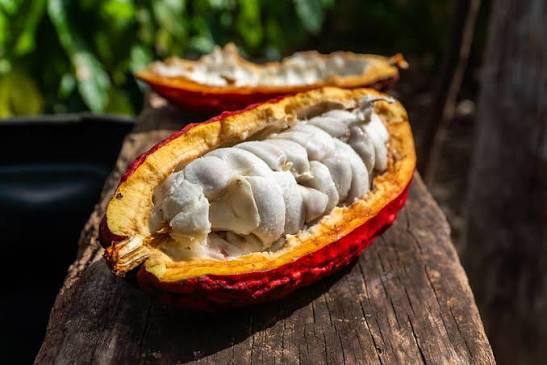
Cacao grows in large pods directly on the trunk and branches of the cacao tree, not on smaller stems like most fruit. Each pod contains 30–50 seeds (the cacao beans) surrounded by a white, tangy-sweet pulp. Pods are cut by hand with machetes when ripe — usually judged by color — because a tree can carry pods at multiple stages of ripeness at once, requiring multiple harvest passes through the same tree over a season.
Step 2: Fermentation
This is arguably the single most important step for flavor, and the one most invisible to consumers. Beans, still coated in pulp, are piled into wooden boxes or wrapped in banana leaves and left to ferment for roughly five to seven days. Heat builds naturally inside the pile as microorganisms break down the sugary pulp, and this process triggers chemical changes inside the bean itself that develop the flavor precursors responsible for chocolate’s eventual taste. Under-fermented beans taste flat, astringent, or overly bitter; well-fermented beans develop the fruity, nutty, or floral notes associated with good chocolate.
Step 3: Drying
After fermentation, beans are spread out to dry — usually sun-dried outdoors on raised beds or patios over one to two weeks, sometimes with mechanical assistance in humid climates. Proper drying brings moisture content down to a stable level for storage and transport while further developing flavor. Beans dried too quickly or unevenly can develop off-flavors, including mold.
Step 4: Sorting and roasting
Once dried cacao beans reach the chocolate maker, they’re sorted to remove any broken, moldy, or underdeveloped beans, then roasted. Roasting develops flavor much like it does for coffee, and the maker chooses roast time and temperature specifically to bring out characteristics of that origin’s beans — a lighter roast tends to preserve bright, fruity notes, while a darker roast pushes toward deeper, more roasted flavors.
Step 5: Cracking and winnowing
Roasted beans are cracked into smaller pieces, then winnowed — a process that separates the lightweight outer shell from the actual cacao nib inside, usually using air flow. The shells are discarded or repurposed (sometimes brewed as cacao tea); the nibs move forward into chocolate-making.
Step 6: Grinding into chocolate liquor
Nibs are ground, generating enough friction heat to liquefy the natural cacao fat (cacao butter) inside them and produce a thick paste known as chocolate liquor or cocoa mass — despite the name, it contains no alcohol. At this stage, it’s essentially unsweetened dark chocolate.
Step 7: Mixing and conching
Sugar (and, for milk chocolate, milk powder or condensed milk) is blended in, and the mixture goes through conching — a prolonged process of grinding and aerating the chocolate to smooth its texture and further develop flavor by driving off unwanted volatile acids. Industrial conching can take a few hours; craft chocolate makers frequently conche for 24 to 72 hours or more, prioritizing flavor development over throughput.
Step 8: Tempering
Tempering is a precise heating-and-cooling process that controls how cacao butter crystallizes inside the chocolate. Done correctly, it produces the glossy finish, clean snap, and smooth melt associated with well-made chocolate; done incorrectly, chocolate turns dull, streaky, or develops a chalky texture (known as bloom).
Step 9: Molding and packaging
Tempered chocolate is poured into molds, cooled, released, and wrapped. For craft makers, this final stage is often still done by hand or in small batches, in contrast to the fully automated packaging lines used by large commodity producers.
Why the process matters more than the marketing

Every one of these steps represents a decision point where flavor can be built up or lost. Craft chocolate makers distinguish themselves largely by the care and intentionality applied at each stage — particularly fermentation, roasting, and conching — rather than by any single ingredient or certification.
Bean to bar usually means starting with nibs. We start with the bean itself — purchased directly from Amazon farming communities, straight from the source. No processors in between, no distance from the farm. That's not bean to bar. That's farm to bar.
Understanding the process is the fastest way to evaluate whether a “craft” claim on a wrapper is backed by anything real. The 70% bar in our own Collection sampler, for instance, is built from High-Amazon Peruvian cacao sweetened with organic coconut sugar rather than refined sugar — a small decision, but the kind that only shows up when someone is paying attention at every stage rather than following a standardized industrial recipe.