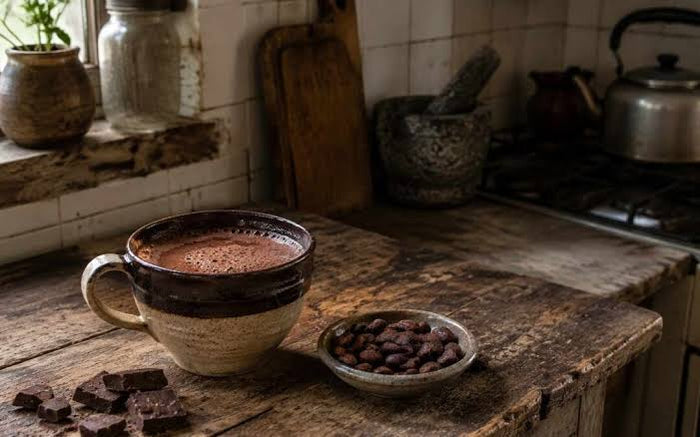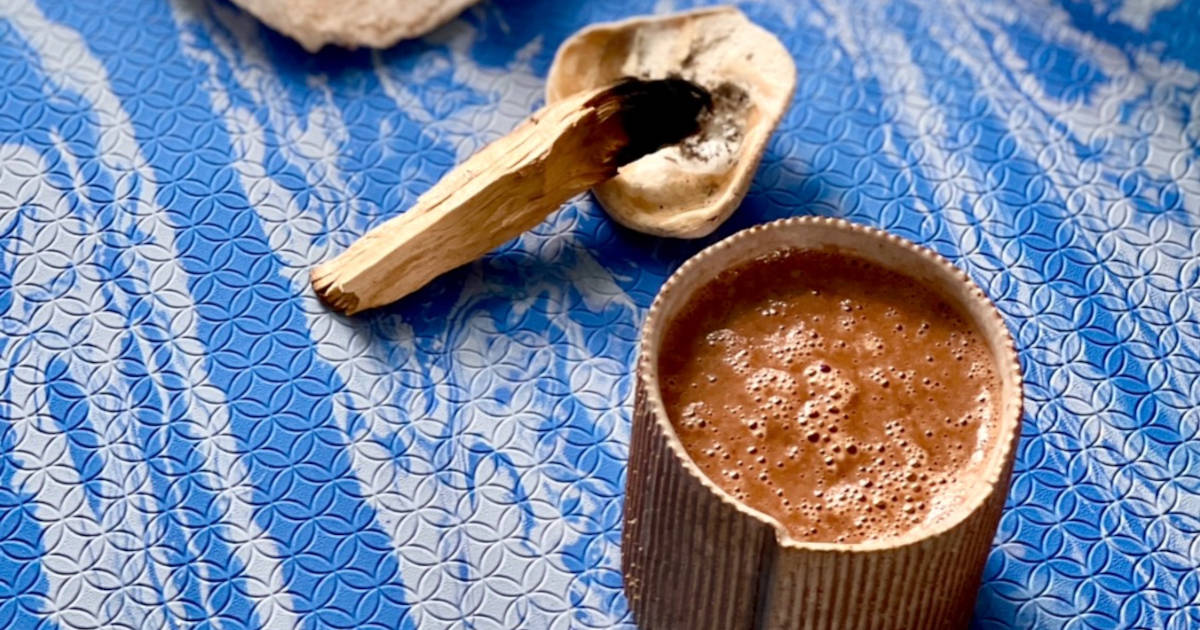
There's no official serving size for ceremonial cacao, which is why two people can both say they drank “a cup” and mean very different things. A cup made with 10 grams and a cup made with 45 grams aren't the same drink, in flavor or in how they feel. This guide gives you our starting points in grams, coins, and ounces, and shows you how to scale them for your day or for a group.
For reference: our everyday starting point is 21 g, about 4 coins, and a deeper ritual cup is 35–45 g. Everything below builds from those two numbers.
The Quick Reference: Three Cups
| Cup | Grams | Coins (approx.) | Ounces | Best for |
|---|---|---|---|---|
| Starter | 10–15 g | 2–3 | 0.35–0.5 oz | Your first cup, afternoons, anyone sensitive to stimulants |
| Everyday | 21 g | 4 | 0.75 oz | A daily morning ritual or a focused work session |
| Deeper ritual | 35–45 g | 7–9 | 1.2–1.6 oz | A personal ceremony or a circle, when you have unhurried time |
Coins weigh about 5 g each (4 coins = 21 g), so coin counts are approximate. If you use a block, weigh your chopped cacao on a kitchen scale.
What Each Cup Means for Caffeine and Theobromine
Cacao is a natural source of two mild stimulants, caffeine and theobromine, so the size of your cup matters for more than flavor. A classic analysis of 22 samples of chocolate liquor (pure ground cacao, the same kind of ingredient as ceremonial cacao paste) found an average of 1.22% theobromine and 0.21% caffeine. Using those averages, here is what each cup works out to:
| Cup | Estimated caffeine | Estimated theobromine |
|---|---|---|
| Starter (10–15 g) | about 20–30 mg | about 120–185 mg |
| Everyday (21 g) | about 44 mg | about 255 mg |
| Deeper ritual (35–45 g) | about 75–95 mg | about 425–550 mg |
Two cautions. These are estimates from a published average, not lab results for our cacao, and individual samples varied a lot: in that same study, the ratio of theobromine to caffeine ranged from about 2.5-to-1 to 23-to-1. For context, the FDA cites 400 mg of caffeine a day as an amount not generally associated with negative effects for most healthy adults, and a typical 8 oz cup of brewed coffee has roughly 80–100 mg. We go deeper in our caffeine and theobromine guide.
How to Choose Your Starting Point
- Your very first cup: start with the starter cup. Going up next time is easy; backing off halfway through a strong cup isn't.
- A daily morning ritual: the everyday cup is our standard for a reason. It's enough to taste the cacao and feel like you made something, without taking over your day.
- A focused work session: the everyday cup, earlier in the day. Add it up with any coffee you've already had.
- An evening cup: go smaller and earlier. In a small study of healthy volunteers, theobromine took about 7 hours to drop by half, versus about 4 hours for caffeine, so a late cup can linger longer than you'd expect.
- A deeper ritual cup: pick a day with unhurried time, skip other stimulants, and treat it as an occasional cup rather than a daily one.
- If you're sensitive to caffeine or take medication: start with the starter cup or less, and read our safety guide first.
Measuring Without Guessing
Coins make this easy: just count them. With a block, chop it and weigh the pieces. Measuring chopped cacao by volume is unreliable, because a spoonful of coarse chunks and a spoonful of fine shavings can differ by several grams. Weigh your usual scoop once on a kitchen scale and you'll know what your own spoon really holds.
Matching Your Liquid to Your Dose
Our standard recipe uses 21 g of cacao with about 7 oz of hot water (or water and the milk of your choice). For deeper cups, we suggest going up to roughly 8–10 oz so the drink stays easy to sip rather than thick as pudding. Prefer it richer? Use less liquid. If you like a little sweetness, honey, panela, or maple syrup all work, and cinnamon, chili, or cardamom are classic additions. Our step-by-step preparation guide walks through the full method.
Dosing for a Group
The math is simple: guests × grams per guest ÷ 454 = pounds of cacao. Add about 10% for spills and seconds.
| Guests | Everyday cups (21 g each) | Deeper cups (35 g each) |
|---|---|---|
| 6 | 126 g (0.28 lb) | 210 g (0.46 lb) |
| 10 | 210 g (0.46 lb) | 350 g (0.77 lb) |
| 20 | 420 g (0.93 lb) | 700 g (1.54 lb) |
As a rule of thumb, a half-pound bag (about 227 g) makes roughly 10 everyday cups or 6 deeper cups, and a full pound makes about 21 everyday cups or 13 deeper ones. Hosting regularly? Our 5 lb and 11 lb bulk sizes come in all three Peruvian origins.
Two things we always recommend when you share cacao: tell everyone what's in the cup and how much, and let people pour a smaller cup or skip it entirely.
How Often Can You Have It?
There's no single answer. Many people enjoy an everyday cup as a regular ritual and save deeper cups for special moments. Whatever you choose, pay attention to your sleep, energy, mood, and heart rate over a week or two, and give yourself rest days when something feels off. If your sleep slips or you feel wired, make the cup smaller or move it earlier before you cut it out entirely.
When to Go Smaller or Ask First
If you're pregnant or breastfeeding, take medication (especially for your heart, blood pressure, or mood), have a heart condition or high blood pressure, or react strongly to stimulants, talk to your healthcare provider before you settle on a dose. We've put the details, with sources, in Is Ceremonial Cacao Safe?
Common Questions
How many coins are in one serving?
Four coins (about 21 g) is our everyday serving. A deeper ritual cup is roughly 7 to 9 coins.
Is more cacao better?
More cacao means more of everything in the cup: more bitterness, more cacao butter, and more caffeine and theobromine. It doesn't automatically mean a better experience, and plenty of people are happiest with the everyday cup.
Can I split a serving into two cups?
Yes. Two smaller cups, a few hours apart, let you adjust as you go and keep each cup lighter.
Does the dose change by origin?
The grams stay the same across our three origins, but the flavor doesn't. High-Amazon Basin is bold and berry-forward, Tropical Desert is brighter and more fruit-forward, and Sacred Valley (Chuncho) is warm and earthy. Flavor may nudge how much you want in a cup.
What if I don't feel anything?
Effects can be subtle. You may notice changes in focus, mood, or presence rather than something dramatic. Instead of chasing it with a bigger cup, try a calm setting, a few slow breaths, and a few days of consistent everyday cups.
Ready to Try It?

Start with the origin that fits your taste: High-Amazon Basin coins, Tropical Desert coins, or Sacred Valley coins. Prefer to chop your own? Each origin also comes as an untempered block.
This article is educational and isn't medical advice. If you have a health condition or take medication, please talk with your healthcare provider before working with ceremonial cacao.