Long before "plant-based omega-3" became a wellness buzz-phrase, farmers in the Peruvian Amazon were already snacking on a small, star-shaped seed that rivals salmon on paper. That seed is sacha inchi (Plukenetia volubilis), and it happens to grow in the same rainforest as the wild cacao we source.
We didn't have to look far to find it. Sacha inchi climbs the same trellises and thrives in the same rich, humid soil as the cacao we work with — which is exactly why it made sense to fold it into one of our new bean-to-bar chocolate bars.
What Is Sacha Inchi?
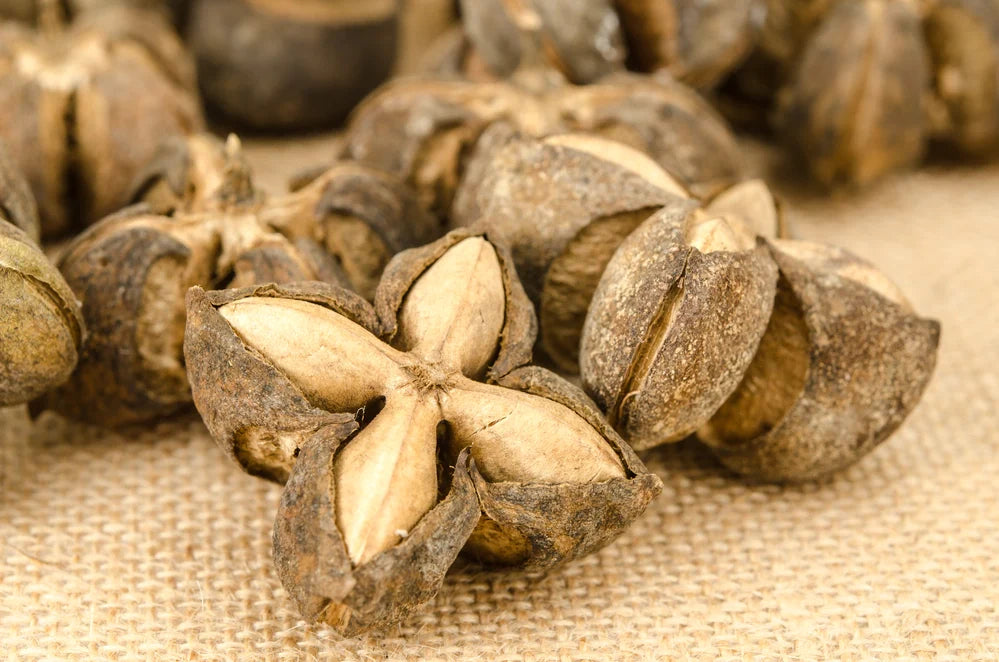
Sacha inchi is a climbing vine native to the Peruvian Amazon, cultivated for thousands of years by indigenous communities. Its fruit forms a star-shaped pod holding several oval seeds — the part we actually eat. Because of their size and shape, those seeds earned the nickname "Inca peanut" or "mountain peanut," even though botanically they aren't related to peanuts at all.
Fresh sacha inchi seeds are bitter and unpleasant to eat raw. Roasting is what unlocks their nutty flavor and turns them into a snack worth reaching for.
What Does Sacha Inchi Taste Like?
Roasted sacha inchi has a mild, nutty flavor often described as a cross between a peanut and an almond, with a drier finish on the palate and a satisfying crunch. That gentle, toasty profile is part of why it pairs so naturally with dark chocolate: it adds texture and roasted depth without competing with the cacao's own flavor.
What the Research Says
Sacha inchi's biggest claim to fame is its fat profile. Cold-pressed sacha inchi oil is exceptionally rich in alpha-linolenic acid, a plant-based omega-3 fatty acid, with published analyses putting omega-3 content near 45–54% of total fatty acids — a notably higher share than most other plant oils.
Researchers have also looked at what that fat profile does inside the body. One study on cold-pressed sacha inchi oil found it showed stronger antioxidant scavenging activity than both olive oil and lard in lab testing, and reduced fat buildup in the liver compared to a saturated-fat diet. Separate human trials have linked several weeks of daily sacha inchi oil intake to reductions in total and LDL cholesterol, alongside improvements in HDL cholesterol. Ongoing clinical research is also examining how sacha inchi combined with CoQ10 affects cardiovascular health markers in adults at elevated cardiovascular risk.
The seeds themselves are also a source of plant protein, vitamin E, and vitamin A — nutrients that are largely preserved when the seed is simply roasted rather than heavily processed.
Where Sacha Inchi Is Found
Sacha inchi grows across tropical parts of the Peruvian, Ecuadorian, and Colombian Amazon, but Peru remains its best-known origin. It thrives in exactly the kind of humid, biodiverse, low-altitude rainforest where our wild cacao is also grown — which made it a natural fit once we started developing our new bean-to-bar line.
Sacha Inchi in Our Chocolate
 We fold roasted sacha inchi seeds, salt, and a touch of pepper into our 70% Dark Chocolate Bar with Sacha Inchi, Salt & Pepper, made with our High-Amazon Basin cacao. The roasted, nutty crunch of the seed against the bar's bright acidity is exactly the kind of pairing you get when an ingredient and the cacao it accompanies grew up in the same forest.
Sacha inchi isn't a trendy imported ingredient for us — it's simply what grows next door to the cacao we've always worked with, and we're glad it finally found its way into a bar.