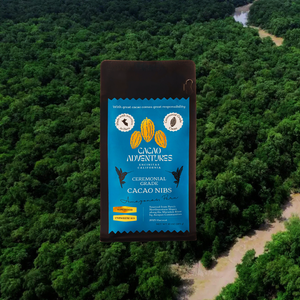
As cacao nibs have moved from niche health stores to mainstream supermarket shelves, the options can be overwhelming but where to buy cacao nibs that are good for you? Not all nibs are created equal. Because they are a raw, minimally processed food, the difference between "industrial" and "artisan" nibs is significant, not just in flavor, but in nutritional density and safety.
If you are looking for where to buy cacao nibs, this guide will help you identify the markers of quality so you can choose a product that supports both your health and the farmers who grow it.

1. Look Beyond the Supermarket Aisle
Most commercial cacao nibs found in big-box grocery stores are sourced through the "commodity" market. In this system, beans from various farms are mixed together, often resulting in a flat, overly bitter flavor that requires heavy roasting to standardize.
When deciding where to buy, look for brands that prioritize Direct Trade. This ensures that the company works directly with indigenous communities or small farming families. This model isn't just about ethics; it’s about quality control. By cutting out the middlemen, producers can ensure the beans are fermented and dried to exact specifications, preserving the delicate floral and fruity notes of the cacao.
2. Check for Purity and Lab Testing
One of the most overlooked aspects of buying cacao is safety. As the International Cacao Organization (ICCO) and various health watchdogs have noted, cacao plants can naturally absorb minerals from the soil.
When sourcing nibs, especially for daily consumption, ask these questions:
-
Is it tested for heavy metals? Reputable suppliers should be transparent about testing for Lead (Pb) and Cadmium (Cd).
-
Is it free of additives? High-quality nibs should have one ingredient: organic cacao. Avoid brands that use "natural flavors" or unnecessary coatings.
At Cacao Adventures, we take this seriously. We drink our cacao daily and share it with our families, which is why we perform third-party lab testing on every single lot—not just occasionally—to ensure it meets strict safety standards. Take a look at our lab test results page.
The Single-Origin Safety Advantage
When you buy mass-produced cacao, you are often consuming a "global blend." Industrial processors typically gather beans from hundreds of different farms across multiple regions, mixing them into massive batches to lower costs.
This makes precise safety testing nearly impossible, as one contaminated harvest can affect the entire lot. By focusing exclusively on single-origin cacao from the High-Amazon Basin, we maintain a closed loop of transparency.
This direct relationship allows us to have full control over the testing process. Because our nibs aren't lost in a sea of anonymous beans, we can verify the soil health and purity of specific harvests, ensuring that every bag meets our rigorous standards for heavy metal safety before it ever reaches your kitchen.
3. Consider the Origin (Terroir)
Just like coffee or wine, the region where the cacao is grown dictates the flavor.
-
High-Amazon Basin (Peru): Known for being the birthplace of cacao, this region produces beans with deep chocolate notes, earthy undertones, and light floral hints.
-
West Africa: Typically produces a more "classic" chocolate flavor but is often associated with larger industrial operations.
For the most "active" and nutrient-dense experience, look for wild or heirloom strains. These native genetics often contain a more complex profile of antioxidants and theobromine than high-yield hybrid trees used in mass production.
The Cacao Adventures Difference: High-Amazon Basin Nibs
If you are looking for nibs that bridge the gap between "superfood" and "gourmet ingredient," our High-Amazon Basin Cacao Nibs are a standout choice.
Sourced directly from indigenous communities in Peru at altitudes of up to 3,500 meters, these nibs offer a sensory experience that industrial brands simply can't match:
-
The Flavor: Naturally nuanced with notes of berries and flora.
-
The Texture: Carefully winnowed to ensure a pleasant crunch that is never "tooth-breaking" or burnt.
-
The Clean Energy: Because they are minimally processed, they provide a gentle, sustained energy boost without the jittery spike of caffeine.
4. Understanding Certifications: What Matters?
While "Organic" is a great baseline, it doesn't always tell the whole story. When choosing where to buy, look for these additional indicators:
-
Keto & Vegan Friendly: Since pure nibs are 100% cacao, they should naturally fit these diets.
-
Gluten-Free: Ensure the facility handles cacao exclusively to avoid cross-contamination.
-
Fair Pay: Look for brands that pay well above the New York commodity price. This ensures the survival of traditional farming methods and the protection of the High Amazon’s biodiversity.
Final Thoughts
You can buy cacao nibs almost anywhere today, but the best nibs are those that remain a "whole food." By choosing transparent, direct-trade sources like Cacao Adventures, you aren't just buying a snack; you are participating in a cycle that respects the land, the farmer, and your own well-being.
Explore our Nibs here