It’s a fair question, and one worth answering honestly rather than deflecting with vague language about “quality.” When a chocolate sampler or bar costs $20–$25 and a comparable-sized bar at the grocery store costs $4, where does the rest of that money actually go?
Cacao cost: paying above commodity price
Commodity cacao is priced on global exchanges, largely disconnected from the quality of any individual harvest, and historically priced low enough that cacao farming has struggled to provide a stable living in many growing regions. Direct-trade and fair-trade sourcing models pay growers meaningfully more than commodity rates — sometimes multiples more — specifically to make cacao farming economically sustainable and to secure access to higher-quality beans that farmers have an incentive to properly ferment and dry rather than rush to market. That premium is paid before a single bean is roasted.
Batch size: no economies of scale

A large commercial chocolate facility can process cacao and produce finished bars by the ton, continuously, with heavily automated equipment running around the clock. Fixed costs — equipment, facilities, labor — get spread across an enormous volume of output, which is what allows a $4 retail price to still be profitable.
Small-batch and craft producers operate at a tiny fraction of that scale. The same fixed costs (equipment, labor, quality control) are spread across a batch that might be a few hundred or a few thousand bars instead of millions. That math alone accounts for a large share of the price gap, independent of ingredient quality.
Time: conching and fermentation aren’t free
As covered earlier in this series, craft chocolate makers often conche a single batch for 24 to 72+ hours, compared to a few hours in industrial production, specifically to develop flavor rather than just achieve workable texture. That’s equipment and facility time tied up for days per batch instead of hours — a direct cost that scales with quality intent, not with volume.
Labor: hands-on at nearly every stage
Sorting beans, monitoring roasts by origin and batch rather than running a single standardized program, hand-tempering or small-batch tempering, and hand-wrapping or small-run packaging all require proportionally far more labor per bar than a fully automated commercial line. This labor cost doesn’t disappear just because the batch is small — if anything, it’s a larger share of the cost per bar precisely because it isn’t diluted across millions of units.
Packaging and fulfillment for smaller brands
Smaller chocolate brands also don’t have the purchasing power to negotiate packaging, shipping, and fulfillment costs down to the same degree as large manufacturers ordering materials by the truckload. A portion of the retail price reflects these real, unavoidable per-unit costs that shrink dramatically at commercial scale but stay relatively fixed for a smaller operation.
What you’re actually buying at that price point
Put together, a $20–$25 chocolate purchase from a craft or bean-to-bar maker is typically reflecting: cacao paid for at a fairer rate than commodity pricing, a batch produced at a scale with no economies of scale to lean on, meaningfully more processing time per bar, and a much higher ratio of hands-on labor to finished product. None of that guarantees the chocolate will taste better to any individual palate — but it does explain, concretely, where the price difference actually comes from, rather than leaving it as an assumption about vague “quality.”
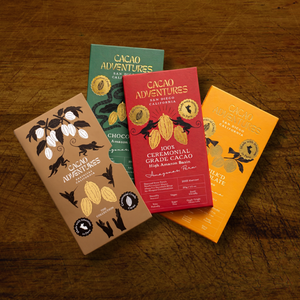
This is close to the exact price point of the Cacao Adventures bean-to-bar chocolate collection — a three-bar sampler built from single-origin Peruvian cacao, sourced directly from small growers rather than commodity markets, spanning 53% to 100% cacao across the set. The same cost logic applies: what you’re paying for isn’t one bar, it’s direct-trade sourcing and three distinct small-batch products instead of one mass-produced one.

Most "bean to bar" makers start with nibs already broken down by someone else. We start earlier than that. We buy whole cacao beans directly from communities deep in the Amazon, working straight with the people who grow and ferment them — no intermediary processors, no anonymous supply chain. That's why we don't just call it bean to bar. It's farm to bar.